
Logan Thomas
Strategic Organizational Communication Major | BYU-Idaho
Senior Project
Helping individuals and teams move from confusion to contribution through practical communication.
Project Overview
People contribute when they understand how they matter.
That simple idea became the foundation of my senior project.
Throughout school, running a business, and leadership experiences, I noticed the same pattern. Teams were communicating constantly, yet many still struggled to move forward. Meetings ended without clear ownership. Good ideas disappeared. Responsibilities became assumptions. Over time, capable people stopped contributing. This wasn’t because they lacked motivation, but because the path forward had become unclear.
The purpose of this project was to create a practical communication framework that helps people reduce confusion before it becomes frustration. Rather than building another communication theory, I wanted to create something students, employees, leaders, managers, and business owners could immediately apply to real situations.
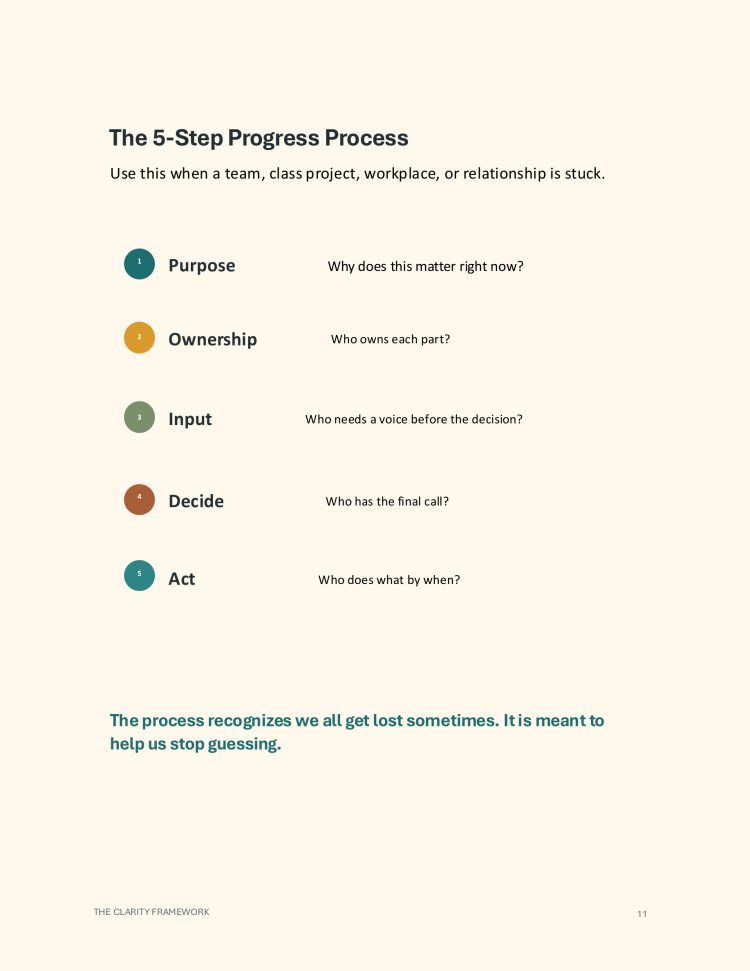
The result was The Clarity Framework, a professionally designed guide that combines research from RAPID decision making, EOS, psychological safety, organizational communication, and leadership principles into one simple, memorable process. The framework centers on five connected ideas: Purpose, Clarity, Trust, Contribution, and Results, then translates those ideas into a practical five step process that helps teams clarify ownership, invite useful input, make decisions visible, and turn conversations into action.
Presenting the project at the BYU-Idaho Senior Showcase reinforced what I learned throughout the semester: effective communication is not simply about saying more. It is about creating enough clarity that people know where they fit, what they own, and how they can confidently move forward together.

The Problem
Communication problems are often mislabeled as people problems.
Throughout school, work, and leadership experiences, I noticed capable people slowly choosing to no longer contribute. It wasn’t because they lacked motivation, but because they no longer understood where they fit, what they owned, or how their work created meaningful progress.
I’ve watched meetings produce conversations without clear decisions. Responsibilities become assumptions. Good ideas often went nowhere. Over time, frustration replaced initiative.
As I researched communication and organizational behavior, I realized the deeper issue wasn’t a lack of communication. It was a lack of clarity.
The Solution
The Clarity Framework was created to help people move from confusion to contribution.
Rather than encouraging people to simply communicate more, the framework helps individuals and teams create greater clarity by answering five essential questions:
• Why does this matter?
• Who owns what?
• Who should provide input?
• Who makes the final decision?
• What happens next?
When those questions are answered consistently, communication becomes more productive, trust grows naturally, and progress becomes easier to sustain.

Research Foundation
The Clarity Framework was built by translating proven communication and leadership principles into a practical tool that people can actually use. Rather than inventing an entirely new model, I combined ideas from established research and simplified them into one framework.
The guide draws from RAPID Decision Making, EOS (Entrepreneurial Operating System), psychological safety research by Amy Edmondson, organizational role theory, and leadership principles from authors such as Simon Sinek, Patrick Lencioni, and Stephen Covey. These sources support the framework’s focus on purpose, role clarity, trust, decision making, and accountability.
Putting the Framework into Practice
One of my biggest goals was to create something that people could use immediately. Too often, communication research stays in textbooks or leadership seminars without translating into everyday conversations.
The Clarity Framework was intentionally designed to bridge that gap. Every section includes practical questions, examples, or action steps that readers can apply right away. Whether someone is leading a team, starting their career, managing a business, or simply trying to improve a relationship, the framework provides a practical way to reduce confusion and create forward movement.
My hope is that readers leave with more than a new perspective. I hope they leave with a tool they can return to whenever a team, project, or relationship feels stuck. For that reason, I included a QR code at the end of the guide that anyone can use to download the full guide and use for free as they see fit.

Project Outcomes
The Clarity Framework became much more than a senior project. It evolved into a practical communication resource designed to help people move from confusion to contribution.
Throughout the semester, I researched communication and leadership principles, developed the framework, refined it through mentor feedback, and transformed it into a professionally designed guide. Presenting the project at the BYU-Idaho Senior Showcase gave me the opportunity to share these ideas with students, faculty, and community members while receiving valuable feedback. The thing that stood out to me most is when my faculty judge said to me: “Don’t let this die here at the showcase”. At that moment, I committed to truly purusing a consulting career. I will create a consulting business. The framework will be amrketed and given to everyone for free. Most people will be able to gain immediate traction in impelmenting the guide without much help. Those that struggle to implement the guide, or simply want additional help or accelerated progress can hire me to help them.
In addition to the guide itself, this project strengthened my skills in strategic communication, research synthesis, visual design, audience centered writing, public speaking, and project management. Most importantly, it taught me how to translate complex ideas into practical tools that people can immediately apply.
Lessons Learned
This project changed the way I think about communication.
I began the semester focused on helping people communicate better. I finished the semester realizing that clarity and simplicity often matters more than volume . More conversations do not always solve confusion. Clear expectations, visible ownership, and shared understanding do.
That insight shaped every part of The Clarity Framework and is a principle I plan to carry into my career. Whether I am working with clients, leading a team, or collaborating on a project, I want to help people create environments where everyone understands how they can contribute.
Final Reflection
If someone remembers only one idea from this project, I hope it is this:
People contribute best when they understand how they matter.
I believe that principle extends far beyond organizations. It applies to classrooms, workplaces, families, friendships, and communities. When people understand their purpose, their role, and how they can contribute, progress becomes possible.
That is the impact I hope The Clarity Framework continues to have long after this project is complete.
The Full guide
Interested in exploring the full framework?
Download the complete 28-page guide to learn more about the research, framework, practical examples, and reflection exercises behind this project.