
Project: Suicide prevention certification, training, and brand development.
Emphasis: Strategic Organizational Communication
Project Summary
At the start of the semester, my goal was to complete a project that would have lasting value. I wanted to build a vehicle that I could continue to “drive” even after the semester ended. After considering a few ideas, I decided to become certified as a QPR suicide prevention trainer and to build a brand that I could continue to grow and advertise over time. This project would not have been possible without the generous scholarship offered by an anonymous individual to cover the cost of the instructor certification, nor without the facilitation and guidance by Professor Andra Hansen.
Instructor Certification
The first step was to become certified as an instructor. After a lengthy preliminary process that spanned several weeks, I was finally able to acquire the training materials. During the interim, I studied additional content on suicide and suicide prevention. I wanted to develop deeper knowledge so that I could be prepared to answer as many questions as possible.
This habit bled over into my study and preparation during the certification process. I spent extra time digging into other resources and going over modules multiple times in order to develop a deeper understanding of suicide, its history, and its place in American culture.

Training & Challenges
As I completed my certification, I began to reach out to businesses and organizations to set up trainings. But I quickly started running into walls. One of the biggest barriers is that, as a trainer, I’m required to provide certain materials for everyone trained. These materials cost $3 per person. And for training sessions with an average of 25 participants, the costs can quickly add up. It was difficult to find groups that were willing to cover the cost of the training materials. Additionally, any kind of training is expensive for companies. It usually requires paying all employees who attend, employees who aren’t working during that time. So I shifted my approach, putting more effort into contacting community groups.
I was able to connect with a young adult group in Jackson, Wyoming that was willing to cover the cost of training materials and I provided 2 training sessions for 40 individuals. The training sessions went terrifically and the participants were highly engaged. It even led to me performing an intervention with a participant after a training. He needed help responding to someone he knew was struggling emotionally, perhaps even in crisis. He disclosed his own battle with mental health and we discussed resources he could turn to in his area.

Building a brand
Along with training, I needed to build a brand. Doing so would enable me to better market my service. I went through several iterations, starting with a bridge concept. I liked the idea of connection and crossing chasms, as well as the grounded feel of the word. However, there was a significant oversight. Bridges are, of course, a means for suicide. It would be inappropriate to use the imagery as part of a brand for a suicide prevention service. So I went back to the drawing board.


My next series of iterations centered on “roots.” Again, I liked the implication of connection and growth, but it didn’t quite feel right. It was a little too “earthy” and I didn’t feel that it represented my abilities and background. It felt more appropriate for a rehabilitation center or therapy clinic, not necessarily a training service. Doing more brand research, I also discovered that it’s a very frequently used image and key word, so it wouldn’t make my service very unique.


I had to dig deeper. I had to figure out what my service was really about and what I wanted to do with it. It also needed to be simple to grasp, marketable, and unique. Finally, “Pal Training” was developed.
The logo is indicative of a speech bubble, implying communication, a core element of suicide prevention. It’s also branded positively, creating a smily face within the speech bubble, because there is hope for the future. QPR has a saying that it creates “merchants of hope.” The icon colors also convey trust and progress, and perhaps nod to the sad and tragic nature of suicide.
And finally, the name, “Pal,” conveys another core element of prevention: relationships. But not necessarily relationships that are intimate and deeply established (though they certainly can be). We teach people how to respond to everyone that’s suicidal, even acquaintances and strangers. Pal is about enabling trainees to recognize and respond to anyone and everyone. We enable them to be a friend, not a full-time therapist, to those they help.

Creating an online presence
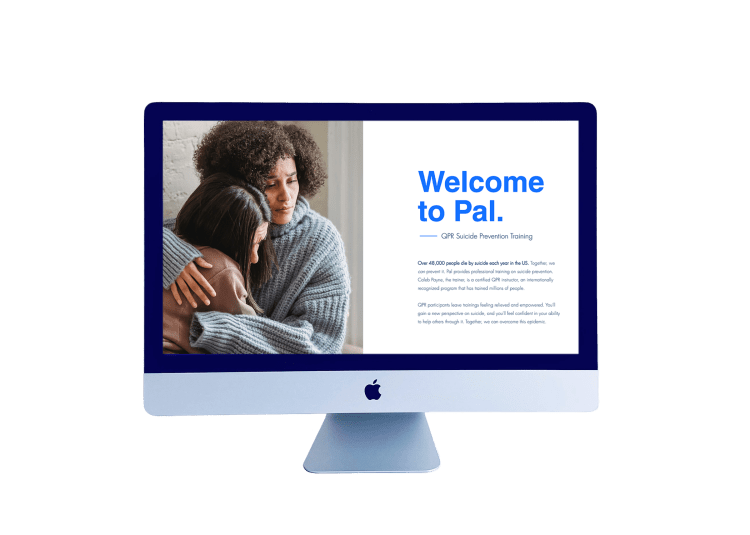
I concluded my project by building an online presence. I created a website to both provide means of communication for interested parties and to support lead generation efforts. I also created a LinkedIn page so that I could better enable the brand to connect and collaborate with corporations through the social networking site.

Time Accounting
| QPR Certification | 14.5 hours |
| QPR Training | 15 hours |
| Branding Design | 6.5 hours |
| Website Build | 5 hours |
| Social Media Setup | 1 hours |
| Outreach | 2 hours |
| Mentor Meetings | 2.5 hours |
| Suicide Research | 2 hours |
| Project Communication | 5 hours |
| Total Time: | 53.5 hours |